Ultra-lean, ACVP-verified, SCA-protected IP core for NIST FIPS 204 compliance. Pure monolithic hardware RTL performing Key Generation, Signing, and Verification without a soft processor or external firmware dependency.
NIST FIPS 204 establishes the post-quantum standard for verifiable firmware, boot, and device authentication.
VIC-ML-DSA-X is a monolithic hardware IP core implementing the NIST FIPS 204 Module-Lattice-Based Digital Signature Algorithm (ML-DSA) standard for ML-DSA-44 and ML-DSA-65. Built as a self-contained hardware state machine without a soft processor or external firmware dependency, it executes key generation, signing, and verification entirely in hardware.
Developed in-house by Vicip with zero third-party IP dependencies, the core synthesizes compactly at 125 MHz (8 ns) on 7-Series FPGA fabric with standard AMBA APB control and AXI4-Stream data interfaces, keeping secret key state internal between KeyGen and Signing without external serialization.
Supports ML-DSA-44 and ML-DSA-65 parameter sets via a single configurable RTL core defined at synthesis time through a Verilog parameter. ML-DSA-87 is currently under active development to complete full parameter-set coverage.
Successfully passes all NIST Automated Cryptographic Validation Program (ACVP) test vectors for ML-DSA Key Generation, Signature Generation, and Signature Verification in RTL simulation. (Simulation-verified; external CAVP lab validation is separate. No CAVP certificate.)
Combines always-on Keccak time desynchronization (pseudo-random cycle stall injection inside the SHAKE/Keccak sponge datapath) with a pre-synthesis optional constant-iteration signing flow on rejected z or h checks. Additional side-channel countermeasures (such as execution shuffling and masked gadgets) are currently under development.
Self-contained hardware state machine with zero embedded CPU or firmware dependencies. Internal secret key state is retained directly between KeyGen and Signature operations without external serialization.
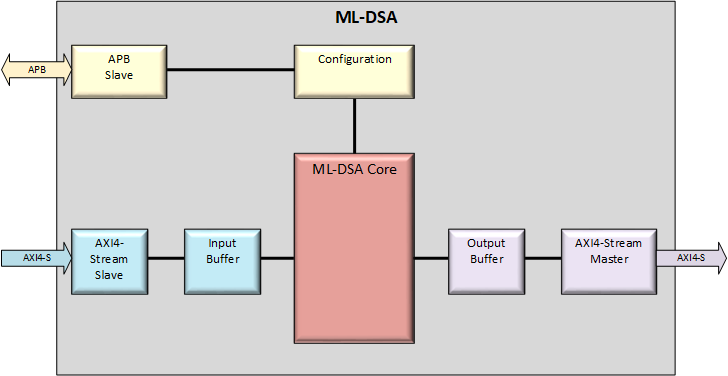
Features an AMBA APB slave control plane and AXI4-Stream data plane (verified in synchronous and asynchronous AXI modes), synthesizing compactly at 125 MHz (8 ns) on Xilinx Artix-7 fabric.
Developed 100% in-house by Vicip with zero third-party IP dependencies. Delivered with synthesizable Verilog/SystemVerilog RTL, self-checking ACVP simulation testbenches, and integration documentation.
The current release provides pre-synthesis standalone builds for ML-DSA-44 and ML-DSA-65 with always-on Keccak random stall injection and optional constant-iteration signing execution. Under Development: Support for the ML-DSA-87 parameter set alongside additional hardware side-channel countermeasures for higher-assurance physical security tiers.
Latency & Throughput Summary — AMD/Xilinx Artix-7 200T, 125 MHz (8 ns clock period). All cycle counts include always-on Keccak random stall injection (with non-zero seed enforcement). Secret key state remains internal between KeyGen and Signature without external serialization:
| Operation | ML-DSA-44 | ML-DSA-65 | Notes |
|---|---|---|---|
| KeyGen (avg, N=500) | 19,805 cyc (158.4 µs) | 30,730 cyc (245.8 µs) | Includes internal NTT setup of s1, s2 |
| Sign (min) | 37,721 cyc (301.8 µs) | 54,540 cyc (436.3 µs) | Init + one accepted iteration (min. observed) |
| Sign (avg, N=500) | 109,564 cyc (876.5 µs) | 172,779 cyc (1.382 ms) | Measured mean ~4.37 / ~4.85 iterations (44/65) |
| Verify | 20,918 cyc (167.3 µs) | 30,853 cyc (246.8 µs) | Valid signature |
| KeyGen + Sign (min) | 57,526 cyc (460.2 µs) | 85,270 cyc (682.2 µs) | Sum of KeyGen (avg) and Sign (min) |
| KeyGen + Sign (avg, N=500) | 129,369 cyc (1.035 ms) | 203,509 cyc (1.628 ms) | Sum of the KeyGen and Sign averages |
FPGA Resource Utilization — AMD/Xilinx Artix-7 200T, 125 MHz (8 ns clock period):
| Metric | ML-DSA-44 | ML-DSA-65 |
|---|---|---|
| Slice LUTs (Logic / Memory) | 18,728 (18,677 / 51) | 18,203 (18,153 / 50) |
| Slice Registers | 11,354 | 11,472 |
| Slices | 6,087 | 5,937 |
| Block RAM Tile | 10.5 | 11.5 |
| DSPs | 32 | 32 |
| F7 / F8 Muxes | 464 / 104 | 412 / 103 |
| BUFGCTRL | 1 | 1 |
Pre-Synthesis Standalone Configurations
Configure ML-DSA-44 or ML-DSA-65 at synthesis time with APB control plane, AXI4-Stream data plane (seeds, keys, messages, and signatures), always-on Keccak random stall injection, and optional constant-iteration signing.
Next-Generation Parameter & Hardening Roadmap
Support for NIST security level 5 (ML-DSA-87) and additional side-channel countermeasures are actively under development. Contact our engineering team for early-access schedules and custom parameter targets.
Integrate our ultra-lean, hardware-accelerated VIC-ML-DSA-X IP core to authenticate critical firmware and communications:
Hardware-enforced firmware, bitstream, and root-of-trust signature verification during system boot without soft-core processor overhead.
Low-latency hardware signing and verification protecting vehicle-to-everything messaging, ECU firmware updates, and in-vehicle gateways.
Compact FPGA acceleration enabling resource-constrained industrial controllers and gateways to authenticate sessions and OTA updates with quantum-safe signatures.
Monolithic RTL without third-party dependencies, tailored for tight logic budgets in spaceborne payloads, command authentication, and telemetry downlinks.
Contact Vicip for evaluation licensing, ASIC target metrics, custom parameter configurations, or early updates on ML-DSA-87 and upcoming SCA features.